


In the hills of eastern Lessinia, in the province of Vicenza, we built a wooden house that is well integrated into its surroundings, designed as a passive building on three levels.
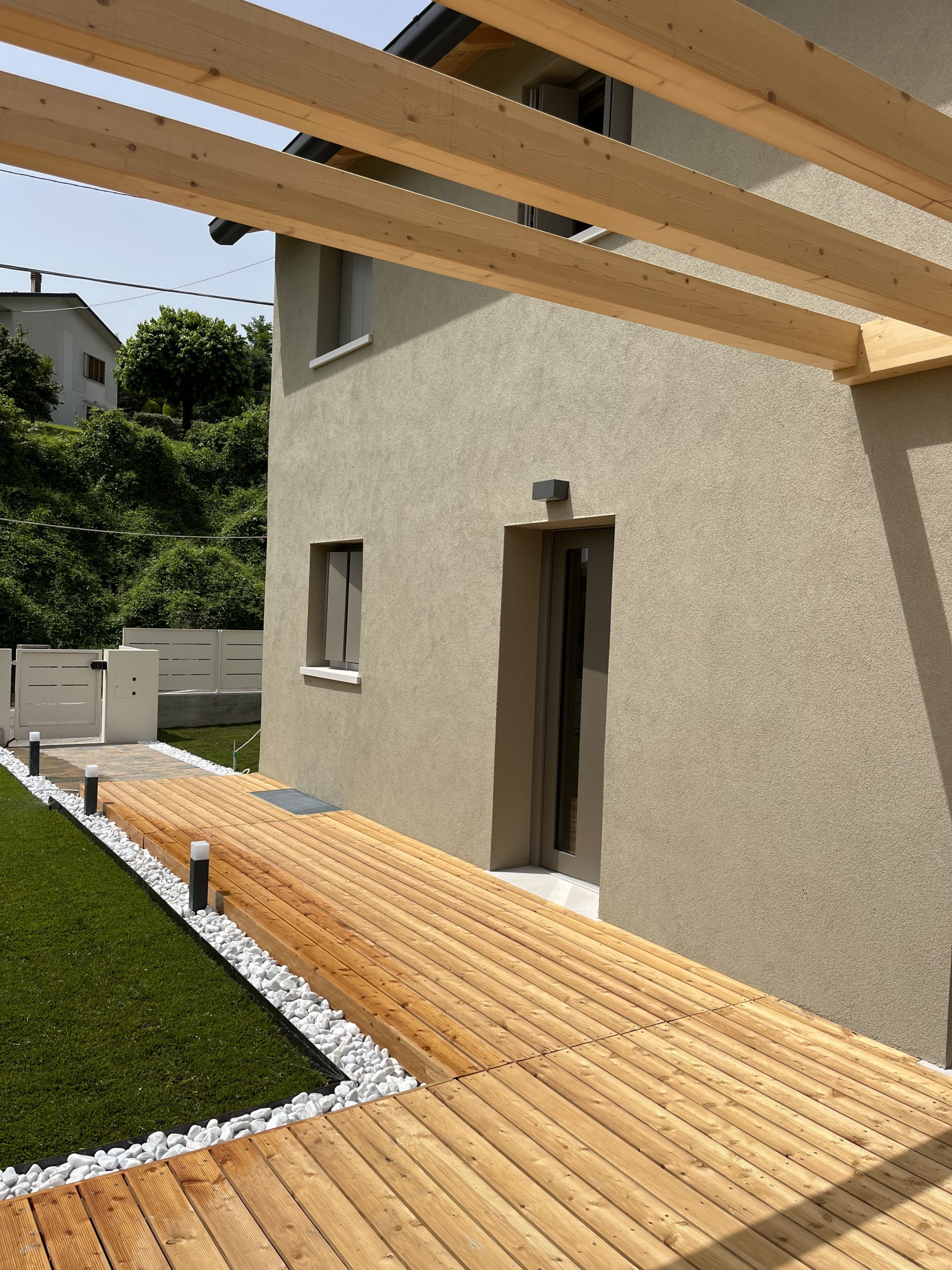
South facade with patio
The design of a wooden house well integrated into the environment
The property has three floors: the ground floor houses the living area, the first floor is dedicated to the sleeping area, and the basement houses the technical room, a bathroom and other service spaces. The project has been approved by the municipality and aims to ensure a wooden house that fits well into the environment, complying with current regulations in rural and hilly areas.
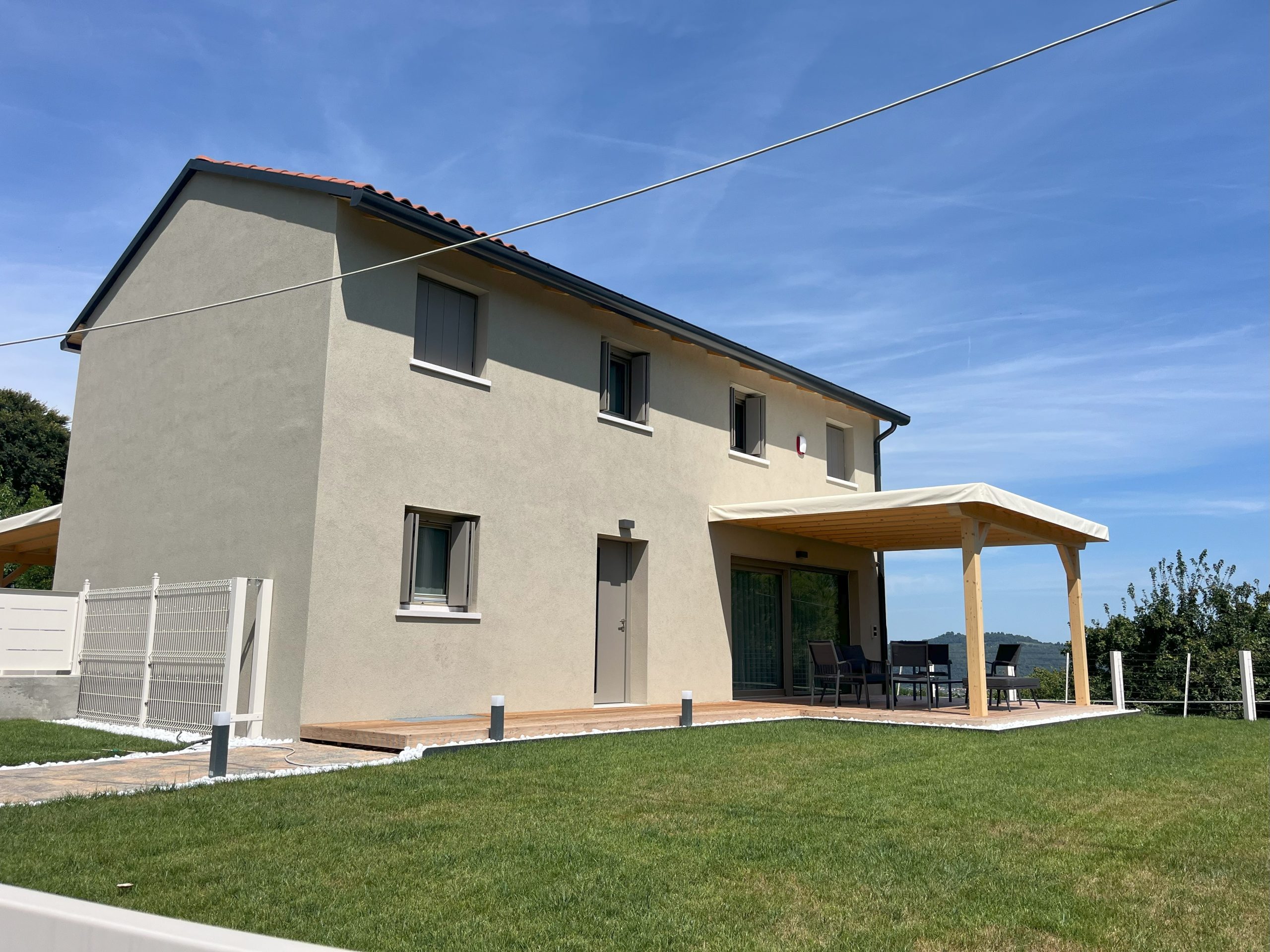
We designed a wooden building that recalls traditional local architecture, with Vicenza-style windows, a gabled roof with regular overhangs, a regular floor plan, and traditional plaster finishes. Thus, we achieved a wooden house that fits well into its surroundings, following criteria of simplicity and formal cleanliness.
This house is designed to live in harmony with the changing seasons, immersed in the beautiful foothills of the Alps, while respecting the natural environment.
The distribution of space in a well-integrated wooden house in the environment
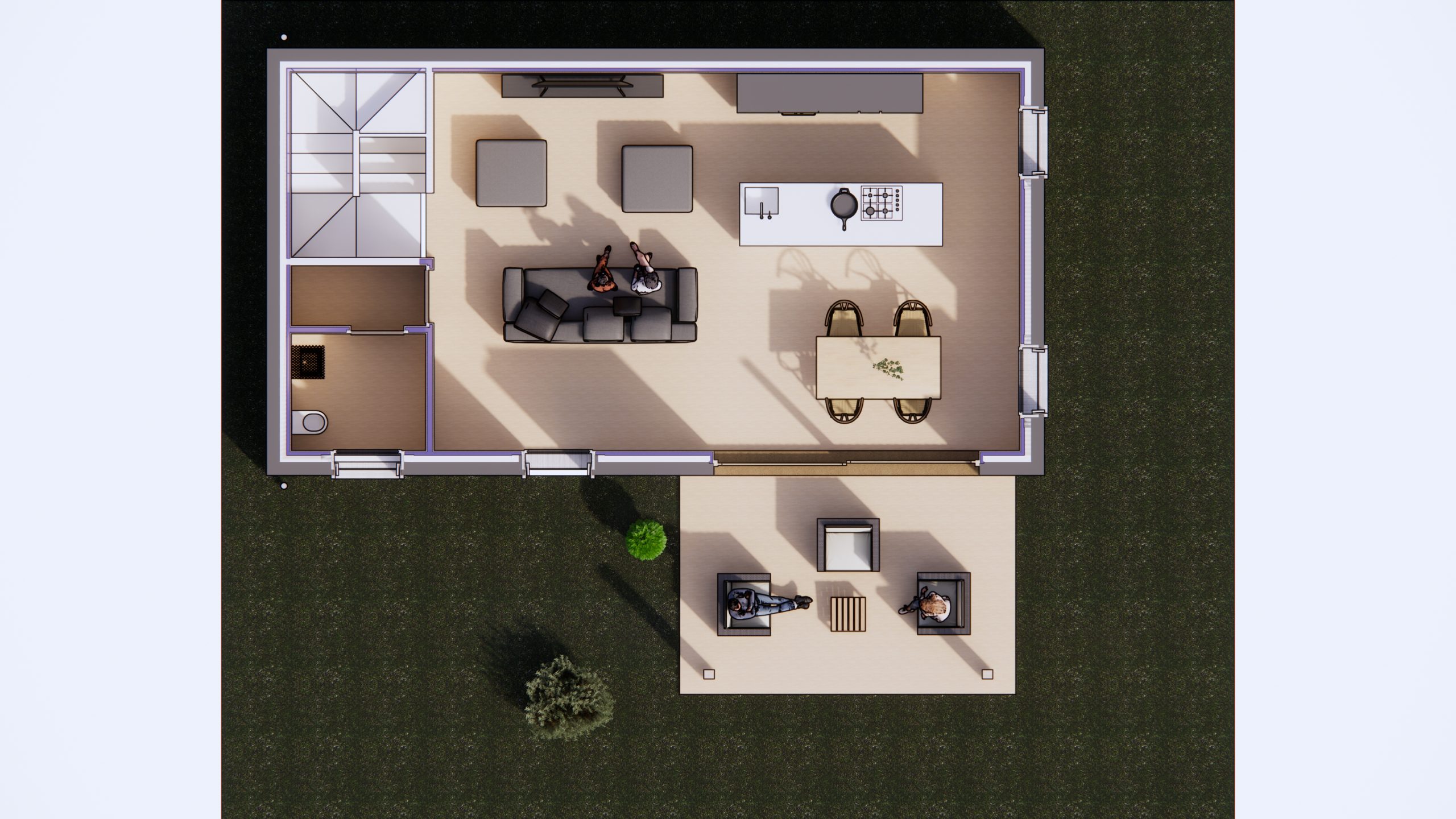
The ground floor plan reflects contemporary living, with a large and inviting kitchen, an open space with TV, and a compliant guest bathroom. A large lift-and-slide window offers stunning views of the surrounding landscape.
The first floor includes three rooms with bathrooms. Each room has wardrobe space and large beds, offering lovely views of the hills.

The basement includes technical rooms and spaces dedicated to leisure and wellness.

An NZEB building
The project was conceived as a NZEB (Nearly Zero Energy Building) building. This was made possible through a series of interventions that ensure energy independence, including:
- Reduction of consumption through high thermal insulation.
- Self-production of electricity through a rich installation of photovoltaic systems.
- Energy storage using storage battery systems.
The systems use only electricity to provide summer and winter air conditioning through heat pumps, with no need for connection to natural gas.
A green building
During its life cycle, this property emits no carbon, helping to improve the planet’s climate.

The vertical load-bearing structure is made of three-layer X-Lam panels, while the floors are supported by glulam beams. The fir bead floors are completed with cross planking in fir planking. Thanks to the PEFC-certified wood structure, we ensure that the material used comes from sustainable forest management, promoting replanting initiatives and removing carbon from the atmosphere.
Thermal insulation
The property has a generous 20 cm of rock wool thermal insulation (external coat), ensuring excellent insulation in both summer and winter.

Controlled Mechanical Ventilation
In this well-integrated wooden house, each room is equipped with an automated air exchange system, known as VMC (Controlled Mechanical Ventilation). This system ensures optimal air exchange, dealing with excess humidity while ensuring recovery of the heat contained in the expelled air. Thanks to this technology, about 90 percent of the heat in the replacement air can be reused.
Kilometer Zero House: a wooden house well embedded in the environment
Following international Passivhaus guidelines, the materials and suppliers used in construction are local. This choice reduces gray energy during construction of the building and improves traceability of supplies, ensuring more effective and timely after-sales service.
Structure in X Lam
X Lam, conceived in the late 1990s by a group of Austrian manufacturers, is an innovative material that makes it possible to create both contemporary and classical architecture with reduced ecological impact. The X Lam structure, while having a similar appearance to traditional masonry, offers numerous advantages:
- Increased speed of construction
- Low power consumption
- Very high seismic resistance
Foundations
The house has an unreinforced concrete lean-to foundation, with a concrete slab (30 cm thick) cast using formwork, according to the project specifications and with proper iron reinforcement.
Insulation Against Ground
At ground level, an insulating layer flanked by a Foamcem lightened screed was made to house the systems.
Vertical Structures
The perimeter load-bearing walls are made of X Lam, manufactured by Artuso Legnami, which guarantees supply and installation of prefabricated walls of the standard type (100 mm thick), complete with steel fasteners. X Lam load-bearing walls are composed, from the inside out, as follows:
- Double sheet of 12.5-mm gypsum board (water-repellent gypsum board will be used for walls facing bathrooms).
- 50-mm cavity for plant passage, insulated with 50-mm rock wool, with 5×4-cm fir laths.
- 3-layer X Lam load-bearing wall, thickness of 100 mm (based on structural calculations).
- Rock wool insulation coat of 200 mm, with density greater than 135 kg/m³ and thermal conductivity of λ = 0.037 W/mK.
- Exterior finish with 5 mm mineral plaster, equipped with plaster carrier mesh and siloxane finish.

Load-bearing Interior Walls in X Lam
The load-bearing interior walls are made of X Lam and consist of:
- Double sheet of 12.5 mm plasterboard (for walls facing bathrooms, water-repellent plasterboard is used);
- 50 mm cavity for the passage of equipment, insulated with 50 mm rock wool, with 5×4 cm fir lath (or thicker for larger diameter pipes);
- Load-bearing wall made of X Lam, thickness of 100 mm in 3 layers (according to structural calculations);
- Last sheet of 12.5 mm gypsum board (again, if facing bathroom, water-repellent gypsum board is used).
Interior Non-Bearing Plasterboard Walls
Non-bearing interior walls are composed of:
- Double sheet of 12.5-mm gypsum board (water-repellent gypsum board for facing bathrooms);
- Metal frame of 75 mm (100 mm for bathrooms or where larger diameter pipes are present);
- Rock wool mattress pad;
- Last sheet of 12.5 mm plasterboard (water-repellent plasterboard where needed).
Roof
The roof supporting structure is made of pre-painted glued laminated timber beams, available in clear, bleached, natural or stained colors. It includes:
- 20-mm wooden bead;
- Planking inclined at 45° by 25 mm;
- Vapor barrier;
- Rockwool Hardrock type rockwool insulation 200 mm, high density, specifically for roofs;
- Battens and counter-battens for ventilation;
- Terracotta roof tiles from Laterizi San Marco, available in various colors.
Photovoltaic System
The photovoltaic system has a capacity of 6.5 kWp and is equipped with integrated panels with inverters, with connection to the GSE to ensure on-site exchange.
Thermal Power Plant
The main generator is an air-to-water heat pump with an output of about 12 kW, used to produce hot water for heating and Domestic Hot Water, as well as to provide cool water for air conditioning and dehumidification during the summer period. There is a 300-liter storage tank for Domestic Hot Water storage.
Heating/ Cooling System
The heating and cooling system is based on a radiant floor. Plasterboard panels with embedded pipes are built into the wall, through which hot water from the heat pump flows, ensures space heating. During summer, cool water flows in the same panels for radiant cooling.
Mechanical Air Conditioning Ventilation System
This system ensures continuous, mechanical air exchange within the home by recovering the heat in the outgoing air (enthalpy). In addition, in summer, the system dehumidifies the air, maintaining a perfectly air-conditioned environment. A well-integrated wooden house thus becomes a pleasant place to live in every season. Mechanical ventilation provides for constant air exchange, taking air from the ‘dirty’ rooms (bathroom, kitchen, laundry room) and feeding it back into the noble rooms (bedrooms, living room) in a balanced way. This process is done through a unit that recovers heat from the extracted air by preheating the fresh air that is fed in. In summer, the dehumidifier, installed on the ventilation supply, provides dehumidified air. This, combined with radiant panels for cooling, ensures optimal air conditioning