


Because price is not just a matter of square footage
Although technical information is in high demand today, the issue of how much a wooden house really costs remains central to anyone approaching this path.
We receive daily contacts via Google and social networks: these are often informed, knowledgeable people with a strong focus on technical aspects such as structures, foundations, thermal insulation, and energy performance. Alongside this, however, a common need always emerges: to understand whether the project is economically viable.
This is true both for those who have a limited budget and for those who, although they have more economic freedom, feel the need to define a clear spending perimeter.
This is why we gladly approach this issue with transparency and sincerity, convinced that starting off on the right foot is essential to build a shared path that leads to the realization of an important project, often long desired.
Online pricing and simplifications
Looking online for a “fair” price for a wooden house may seem like the natural first step, but it is not always the most effective.
It often happens that very synthetic values are reported, sometimes built on simplified assumptions, which do not take into account a multiplicity of relevant cost items. In many cases these are prices referring to partial configurations, with exclusions emerging only at a later stage in the process.
The risk of these simplifications is not so much in the number itself, but in the expectations they generate. Sooner or later, in fact, all the necessary components of making a home must be considered, and putting off this realization can make the path more complex and less serene.
Because price is not just a matter of square footage
One of the first questions we receive is almost always the same:
“How much does a wooden house cost per square meter?”
It is a legitimate, understandable question, but also a deeply reductive one.
Not because it is wrong, but because it tells almost nothing about what it really takes to build a home without surprises.
In our work we have learned that the cost of a house is not a number, but a process.
The myth of “linear” cost
We are used to thinking that the cost increases proportionally:
more square meters → more expense.
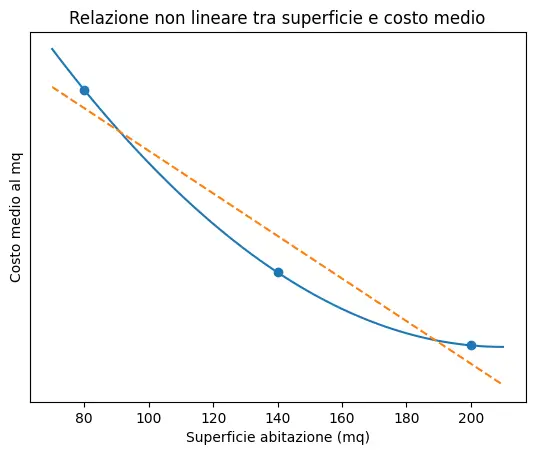
In reality, in the construction of a house, this relationship is not linear.
Many costs are:
-
fixed
-
Or only weakly affected by the surface
Installations, technical expenses, connections, site organization, construction management and administrative management affect a 90 m² house and a 200 m² house similarly.
The result is an unintuitive but real truth:
smaller houses often have a higher cost per square meter, not because they are built worse, but because some costs do not reduce proportionally to floor area.
Because the price per square meter is only an average
Price per square meter can be useful as an order of magnitude, but it becomes misleading when used as the sole decision-making criterion.
Two dwellings with the same floor area can have very different costs depending on:
-
structural scheme
-
plant level
-
energy performance
-
degree of customization
-
complexity of the project
And especially based on when these choices are made:
before or during construction.
Many economic problems arise not from particularly costly choices, but from decisions made too late.
Cost as a consequence of the method
In our work we have chosen not to start from the final price, but from the method.
Even before the construction site, there is a fundamental phase in which:
-
the project is deepened
-
the cost is broken down into its main items
-
consistency between desires, budget and actual feasibility is checked
This step is not to “make an estimate,” but to validate the path.
This is the time when it is understood whether a house can be built without forcing, sudden relinquishment or unnecessary tension.
Budget not as a limitation, but as a tool
Asking for a budget reference at first may seem like an awkward question.
It is actually one of the most useful tools for designing well.
The budget is not to say what cannot be done, but to understand:
-
Whether the project is realistic
-
where it pays to invest
-
Where it is more appropriate to simplify
A stated budget opens to dialogue.
An unshared budget creates expectations that are difficult to manage.
Building a house is a small marathon
A construction site is not a sprint.
It is a marathon of decisions, contingencies, adjustments and collaboration.
Leaving is relatively easy.
Arriving well requires:
-
method
-
clarity
-
mutual trust
That is why we believe it is important to understand each other from the very beginning, even before signing a contract or starting work.
We ask our potential client to listen and cooperate, and we are convinced that it is necessary, in a sense, to like each other and take the time to get to know each other, analyzing together the goals to be pursued.
Why a small engineering firm can make a difference
Lignodesign is a deliberately lean entity, structured as an engineering company.
It is a specific choice, not a random one.
This approach allows us to:
-
design, estimate and build as one process
-
Evaluate each choice also from an economic and implementation point of view
-
avoid disconnects between project and construction site
It is not a model designed to make big numbers, but to carry projects through to the end, without surprises.
Value of the result
Each of our projects is different because it is created to respect the individuality of the clients, honoring their personal tastes, aesthetic and functional expectations.
Context plays a key role: a house requires proper environmental integration, often governed by zoning regulations but also by common sense. Contemporary architectural trends do not always fit with existing constraints, and this requires design synthesis skills.
One of the central aspects of our work is theoptimization of resources.
Many projects are burdensome even in the initial set-up, due to unrational structural schemes. Therefore, one of the first analyses we carry out concerns the rationalization of the floor plan, with the aim of combining functional needs and proper distribution of loads.
This path allows us to build wooden houses that meet shared aesthetic, functional and energy criteria, while representing a solid and lasting investment.
In conclusion
Asking “how much does a wooden house cost” is natural.
But the more useful question is another:
“What is the right path to build it smoothly?”
Cost is not only the starting point.
It is the result of choices made methodically, at the right time.
